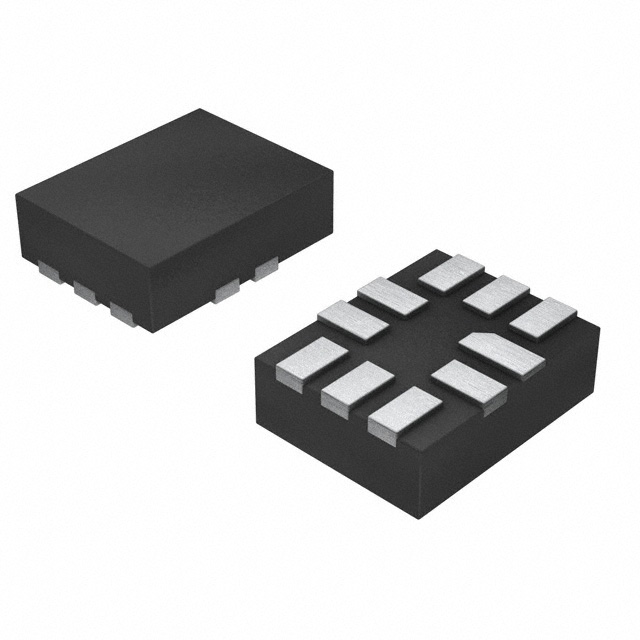
Key Specs
| Spec | Value | Condition | Source |
|---|---|---|---|
| 3db Bandwidth | 45 kHz | Digi-Key | |
| Amplifier Type | Current Sense | Digi-Key | |
| Current Input Bias | 500 pA | Digi-Key | |
| Gain Bandwidth Product | 45 kHz | Digi-Key | |
| Mounting Type | Surface Mount | Digi-Key | |
| Number Of Circuits | 1 | Digi-Key | |
| Operating Temperature Range | -40°C ~ 125°C (TA) | Digi-Key | |
| Output Type | Rail-to-Rail | Digi-Key | |
| Package Case | 10-UFQFN | Digi-Key | |
| Quiescent Current (Typ) | 40µA | Digi-Key | |
| Slew Rate | 0.25V/µs | Digi-Key | |
| Supplier Device Package | 10-UQFN (1.8x1.4) | Digi-Key | |
| Voltage Input Offset | 2 µV | Digi-Key | |
| Voltage Supply Span (Max) | 5.5 V | Digi-Key | |
| Voltage Supply Span (Min) | 1.7 V | Digi-Key |
When To Use
-
Battery current monitoring → 12V @ 10A: The 45 kHz gain bandwidth product and 3 dB bandwidth up to 45 kHz make INA190A1IRSWR suitable for measuring moderate-frequency current signals with minimal phase delay. Its extremely low input bias current of 500 pA ensures accurate measurement of small shunt voltages without offset drift. Using a higher-bandwidth current-sense amplifier here can introduce excessive noise and complicate filtering, potentially causing false current spikes.
-
Motor control feedback → 24V @ 5A: The rail-to-rail output and low offset voltage (2 µV) allow precise current sensing in low-voltage motor drive loops, while the 10-UQFN package’s small footprint (1.8x1.4 mm) minimizes PCB area. A larger package amplifier would increase PCB real estate and complicate thermal management, risking thermal runaway in a congested layout.
-
Power supply current monitoring → 3.3V @ 2A: The low quiescent current of 40 µA supports continuous sensing without significantly impacting battery life. The 10-UQFN package requires careful layout to maintain thermal conduction through the exposed pad, ensuring stable operation. Using a part with a larger quiescent current would degrade overall power efficiency and potentially cause thermal issues in compact designs.
When Not To Use
-
High-frequency switching node current ≥ 200 kHz: The gain bandwidth product of 45 kHz is insufficient for accurate sampling of high-frequency switching currents. Use a higher-bandwidth current-sense amplifier to avoid aliasing errors and distorted waveform capture.
-
Measuring >50 A bus current in automotive systems: The power dissipation in the shunt resistor and input range limitations make INA190A1IRSWR unsuitable for high-current sensing where shunt losses become prohibitive. Use a Hall-effect current sensor to avoid thermal runaway and excessive power loss in the sensing resistor.
-
Current measurement with galvanic isolation requirements: INA190A1IRSWR lacks built-in isolation, so it cannot safely measure currents on high-voltage rails requiring galvanic isolation. Use an isolated current-sense amplifier to prevent latch-up or damage due to ground potential differences.
Application Notes
-
The exposed thermal pad under the 10-UQFN (1.8x1.4 mm) package must be soldered to a large PCB copper area with multiple thermal vias to the inner or bottom layers to maintain junction temperature within operating limits and prevent thermal drift.
-
Pins 1 and 10 are supply and output pins, respectively; noise coupling on these pins from switching nodes (SW) nearby must be minimized by careful ground and power plane segmentation and short, low-inductance routing.
-
The input pins, especially the current-sense inputs, are sensitive to common-mode noise and should be routed as a symmetrical pair with a Kelvin connection to the shunt resistor to avoid offset errors.
-
Guard traces or ground shields around input pins should be used to minimize leakage currents and maintain the low 500 pA input bias current performance.
-
Avoid routing high di/dt switching signals under or near the 10-UQFN package to prevent capacitive coupling into the sensitive input pins that can cause output jitter or offset shifts.
Related Calculators
- Current Sense / Shunt Resistor Calculator — Size your shunt resistor for this amplifier
Gotchas
-
[Thermal path underestimation]: Assuming the small 10-UQFN package dissipates heat solely through the leads leads to elevated junction temperatures during continuous 40 µA quiescent current operation, causing gain drift.
What happens: Output offset drifts over time, visible as slow baseline shift on the output.
Fix: Measure PCB thermal impedance with thermal vias under the exposed pad and ensure the thermal pad is soldered to a copper plane with multiple vias. -
[Input bias current offset drift due to PCB contamination]: In high-humidity or dirty PCB environments, leakage currents across the PCB surface near input pins increase, offsetting the 500 pA input bias current specification.
What happens: Erratic output offset and increased noise floor, especially at low input currents.
Fix: Use conformal coating or guard ring routing around input pins, and clean the PCB thoroughly before assembly. -
[Startup offset spike when supply ramps slowly]: If the supply voltage rises slowly and non-monotonically (e.g., brownout conditions), the INA190A1IRSWR output can saturate or latch temporarily due to internal input stage biasing conditions.
What happens: Output stuck near rail during startup, causing false current readings for several milliseconds.
Fix: Ensure a clean, monotonic supply ramp with a dedicated power supervisor or reset circuit. -
[Incorrect sense resistor Kelvin connection]: Running the sense resistor Kelvin return through a noisy ground or power line instead of a dedicated low-impedance Kelvin path causes input offset and output jitter.
What happens: Output fluctuates with load switching noise, not correlated with the actual current.
Fix: Use separate Kelvin traces directly from the shunt resistor terminals to the INA190A1IRSWR input pins with minimal loop area.