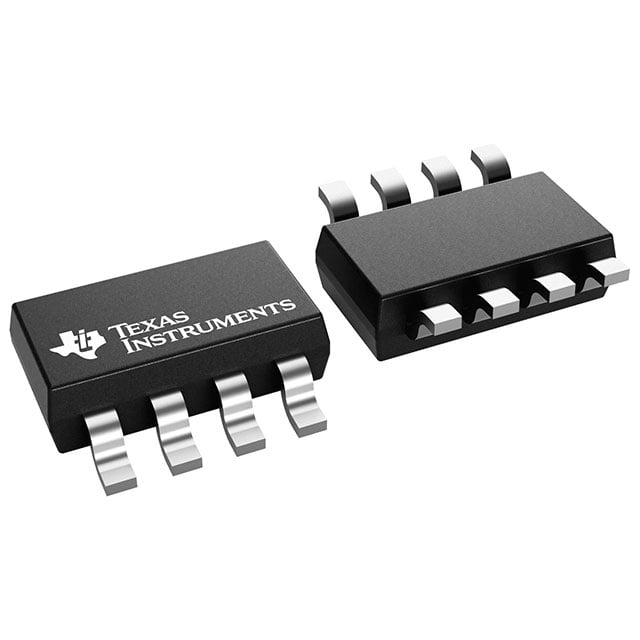
Key Specs
| Spec | Value | Condition | Source |
|---|---|---|---|
| Amplifier Type | Current Sense | Digi-Key | |
| Current Input Bias | 500 pA | Digi-Key | |
| Gain Bandwidth Product | 45 kHz | Digi-Key | |
| Mounting Type | Surface Mount | Digi-Key | |
| Number Of Circuits | 1 | Digi-Key | |
| Operating Temperature Range | -40°C ~ 125°C (TA) | Digi-Key | |
| Output Type | Rail-to-Rail | Digi-Key | |
| Package Case | SOT-23-8 Thin, TSOT-23-8 | Digi-Key | |
| Quiescent Current (Typ) | 48µA | Digi-Key | |
| Slew Rate | 0.3V/µs | Digi-Key | |
| Supplier Device Package | TSOT-23-8 | Digi-Key | |
| Voltage Input Offset | 3 µV | Digi-Key | |
| Voltage Supply Span (Max) | 5.5 V | Digi-Key | |
| Voltage Supply Span (Min) | 1.7 V | Digi-Key |
When To Use
-
Low-side current sensing in 5V digital systems @ 10A: The ±0.2% max gain error and 3 µV typical input offset voltage ensure precise current measurement in low-voltage rails where accuracy affects control loops or power budgeting. Alternative current-sense amplifiers with higher offset would cause significant measurement drift, leading to overcurrent faults or inefficient power management.
-
Battery management system in handheld device, operating -40°C to 125°C: The wide operating temperature range combined with ultra-low quiescent current (48µA) suits battery-powered equipment requiring stable current sensing over temperature extremes. Using a higher-bandwidth current-sense amplifier with higher quiescent current would reduce battery life unacceptably.
-
Power-gated current sensing in duty-cycled IoT firmware (−40°C to 125°C ambient): The TSOT-23-8 package includes an ENABLE pin (VIH = 1.2V, VIL = 0.4V) that allows a microcontroller GPIO to disable the INA190A1IDDFR between measurement intervals, dropping supply current from 48µA to 100nA maximum — a 480× reduction. In a system sampling current every 10 seconds with a 100ms active window, this reduces CSA energy use by 99%. Using the SC-70-6 variant (no ENABLE pin) requires an external series MOSFET to achieve equivalent power gating, adding BOM cost and layout area.
When Not To Use
-
High-frequency motor drive current sensing (>100 kHz switching): The 45 kHz gain bandwidth product is insufficient to capture fast transient currents accurately. Use a higher-bandwidth current-sense amplifier instead to avoid signal distortion and missed transient events.
-
Measuring high-side current with galvanic isolation requirement: The device lacks isolation and cannot handle high common-mode voltages beyond the input range. An isolated current-sense amplifier is necessary to prevent latch-up or damage from voltage transients.
-
Current monitoring with digital telemetry and power accumulation: INA190A1IDDFR outputs analog signals only and has no integrated communication interface. For systems requiring digital readout and power logging, choose an integrated digital current/power monitor with I²C/SMBus interface.
Application Notes
-
The TSOT-23-8 package has limited thermal dissipation area; place the device close to the shunt resistor with a solid copper pour on the PCB’s thermal pad to improve heat spreading and reduce temperature rise.
-
the Enable pin must see a clean logic signal with VIH >1.2 V for reliable activation and VIL <0.4 V for shutdown; slow or noisy enable signals near these thresholds may cause erratic output states.
-
Pins 2 and 3 are the differential input nodes; route these traces symmetrically and keep them short and shielded from switching nodes (SW) to minimize noise pickup and common-mode interference.
-
Avoid placing high-frequency switching nodes or noisy power traces near the input pins; guard routing or ground shielding around the input traces reduces coupling and offsets caused by EMI.
-
The output is rail-to-rail; however, slew rate is limited to 0.3 V/µs, so expect slower response to step changes—account for this in high-speed feedback loops or transient detection.
Related Calculators
- Current Sense / Shunt Resistor Calculator — Size your shunt resistor for this amplifier
Gotchas
-
Enable pin threshold margin misunderstood: An engineer may assume any 1.0 V logic level triggers enable, but the typical VIH is 1.2 V, and VIL is 0.4 V. If the enable input voltage hovers near this undefined region, the device output can oscillate or fail to enable, causing intermittent current measurement.
Fix: Measure the actual enable voltage at the PCB and ensure it exceeds 1.2 V cleanly or is pulled below 0.4 V with no intermediate levels. -
Thermal path underestimated due to TSOT-23-8 package size: The small footprint limits heat dissipation; a dense PCB layout without thermal vias or copper pours can cause junction temperature to exceed maximum ratings during continuous high current sensing, degrading accuracy or causing device damage.
Fix: Use thermal vias and adequate copper area beneath and around the package to maintain junction temperature within datasheet limits. -
Input bias current impact on high-value shunt resistor: The 500 pA input bias current, though low, can cause measurable voltage drops across large shunt resistors, skewing low-level current measurements unnoticed in simulation.
Fix: Verify input bias current effect by calculation for the chosen shunt resistor and adjust resistor value or amplifier gain accordingly. -
Output loading affecting stability: Connecting the output to a low-impedance load or large capacitive load without a proper buffer can induce output ringing or instability due to the limited 0.3 V/µs slew rate and internal output stage design.
Fix: Add a small series resistor or buffer amplifier at the output to maintain stable operation and clean output signal.