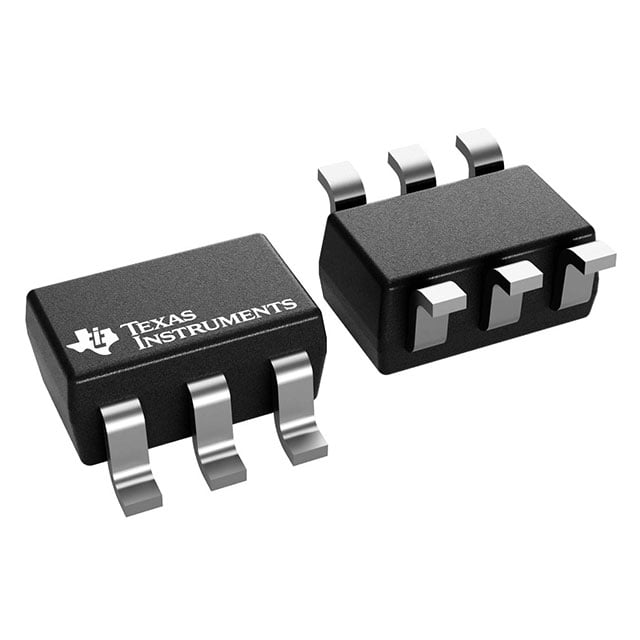
Key Specs
| Spec | Value | Condition | Source |
|---|---|---|---|
| Amplifier Type | Current Sense | Digi-Key | |
| Current Input Bias | 500 pA | Digi-Key | |
| Gain Bandwidth Product | 45 kHz | Digi-Key | |
| Mounting Type | Surface Mount | Digi-Key | |
| Number Of Circuits | 1 | Digi-Key | |
| Operating Temperature Range | -40°C ~ 125°C (TA) | Digi-Key | |
| Output Type | Rail-to-Rail | Digi-Key | |
| Package Case | 6-TSSOP, SC-88, SOT-363 | Digi-Key | |
| Slew Rate | 0.3V/µs | Digi-Key | |
| Supplier Device Package | SC-70-6 | Digi-Key | |
| Voltage Input Offset | 3 µV | Digi-Key | |
| Voltage Supply Span (Max) | 5.5 V | Digi-Key | |
| Voltage Supply Span (Min) | 1.7 V | Digi-Key |
When To Use
-
High-side current sensing in low-voltage systems (1.7V to 5.5V supply): The INA190A1IDCKR’s low minimum supply voltage of 1.7V and rail-to-rail output make it well suited for current sensing in low-voltage digital or battery-powered systems. A device with a higher minimum supply voltage would either fail to operate or produce inaccurate output near the rails, causing measurement errors or saturation.
-
Precision current measurement with minimal offset drift in industrial sensors: The extremely low offset voltage (max ±15 µV) and offset drift (80 nV/°C max) enable accurate long-term current monitoring where temperature varies from −40°C to +125°C. A higher offset amplifier would accumulate error over temperature, resulting in incorrect power calculations or false fault detections.
-
Space-constrained PCB current sensing in portable or handheld equipment: The SC-70-6 package provides a very small footprint, minimizing PCB area and allowing dense layout in handheld devices. However, this package requires careful layout to ensure thermal path and rework feasibility; larger packages would be easier to handle and dissipate heat but consume more board area, which might not be available.
When Not To Use
-
High-frequency, fast transient current sensing (>45 kHz bandwidth required): The gain bandwidth product of 45 kHz limits response speed. Use a higher-bandwidth current-sense amplifier for applications such as fast switching power supplies or motor control where slew rate and bandwidth must exceed INA190A1IDCKR’s 0.3 V/µs and 45 kHz.
-
Measuring very high currents (>50A) where shunt resistor power dissipation is critical: The need for a shunt resistor with this amplifier creates excessive I²R losses at very high currents. An engineer should use a Hall-effect current sensor to avoid thermal runaway and power loss associated with large shunts.
-
Applications requiring galvanic isolation across the high-side rail for safety or noise immunity: Since the INA190A1IDCKR is not isolated, it cannot protect against ground loops or high-voltage transients. An isolated current-sense amplifier is necessary to prevent latch-up or damage in these environments.
Application Notes
-
The SC-70-6 package’s small size limits copper area for heat dissipation; maximize thermal vias and a solid ground plane under the device to improve thermal conduction and reduce junction temperature.
-
The IN− and IN+ pins are the current-sense inputs; keep sense traces short and routed as a Kelvin connection to the shunt resistor to minimize parasitic resistance and noise pickup.
-
The OUT pin is sensitive to noise coupling; route the output trace away from switching nodes (SW) or noisy digital signals and use guard traces or ground fills to reduce EMI susceptibility.
-
Avoid placing large output capacitors on VOUT; the amplifier’s stability is optimized for low output capacitance to maintain the 0.3 V/µs slew rate and prevent oscillations.
Related Calculators
- Current Sense / Shunt Resistor Calculator — Size your shunt resistor for this amplifier
Gotchas
-
[Offset drift ignored in temperature cycling]: Assuming the ±15 µV offset and 80 nV/°C drift are negligible leads to cumulative error in temperature-varying environments. This manifests as slow output drift and inaccurate current readings during system thermal cycles. Fix by characterizing offset over the expected temperature range and applying software compensation or calibration.
-
[Insufficient thermal relief on SC-70-6 pads]: Designers often treat this small package like larger ones and omit thermal vias or copper pours, causing junction temperature rise and potential long-term reliability issues. The symptom is elevated die temperature without visible external overheating. Fix by implementing dedicated thermal vias and maximizing copper area under the device.
-
[REF pin left floating for unidirectional sensing]: The DCK (SC-70-6) package exposes the REF pin (pin 1). For unidirectional current sensing, REF must be tied to GND to set the zero-current output at GND level. Leaving REF floating produces an undefined output offset — often a mid-rail voltage — that will be mistaken for a large shunt current. Fix: tie REF to GND unless you are intentionally using the REF pin to enable bidirectional sensing with an external voltage reference.
-
[Incorrect Kelvin connection for sense inputs]: Routing VS+ and VS− sense lines directly to the shunt resistor terminals without Kelvin connections leads to additional trace resistance in series, causing gain errors and offset shifts. This appears as systematic measurement offset that changes with PCB temperature. Fix by running separate sense traces directly from the resistor terminals to the amplifier inputs.