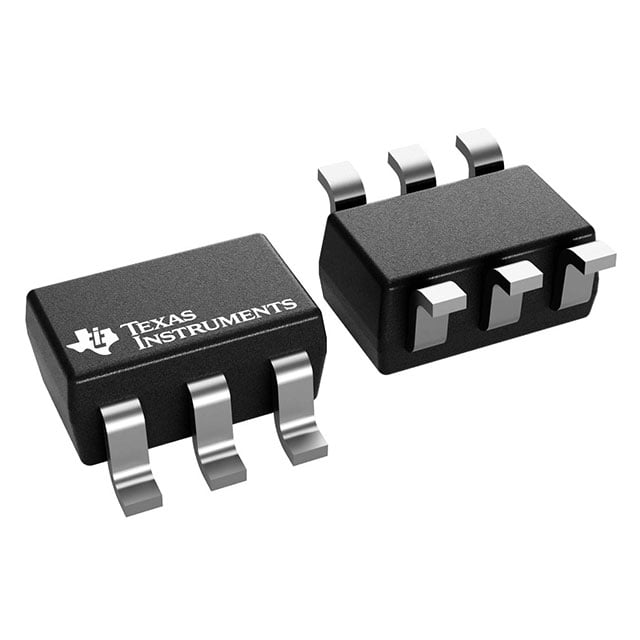
Key Specs
| Spec | Value | Condition | Source |
|---|---|---|---|
| Amplifier Type | Current Sense | Digi-Key | |
| Current Input Bias | 500 pA | Digi-Key | |
| Gain Bandwidth Product | 35 kHz | Digi-Key | |
| Mounting Type | Surface Mount | Digi-Key | |
| Number Of Circuits | 1 | Digi-Key | |
| Operating Temperature Range | -40°C ~ 125°C (TA) | Digi-Key | |
| Output Type | Rail-to-Rail | Digi-Key | |
| Package Case | 6-TSSOP, SC-88, SOT-363 | Digi-Key | |
| Quiescent Current (Typ) | 48µA | Digi-Key | |
| Slew Rate | 0.3V/µs | Digi-Key | |
| Supplier Device Package | SC-70-6 | Digi-Key | |
| Voltage Input Offset | 3 µV | Digi-Key | |
| Voltage Supply Span (Max) | 5.5 V | Digi-Key | |
| Voltage Supply Span (Min) | 1.7 V | Digi-Key |
When To Use
-
Low-current battery monitoring (3.3V @ 100mA): The extremely low input bias current of 500 pA and 3 µV offset voltage allow precise measurement of microamp-level shunt currents without significant error or offset drift. A higher-offset or higher-bias current amplifier would introduce offset voltages that mask small currents, leading to inaccurate SoC calculations.
-
Precision motor current sensing at low frequency (5V supply, 2A load): The 35 kHz gain bandwidth product and 0.3 V/µs slew rate match well with slow to moderate transient response in brushed DC motors, ensuring accurate current waveforms without the instability that a higher-bandwidth amplifier might show due to noise coupling. Using an amplifier with insufficient bandwidth would cause output slew limiting and distorted current waveforms during load steps.
-
Battery-powered sensor nodes (1.8V to 5.5V supply): The wide supply voltage span from 1.7 V to 5.5 V and low quiescent current (48 µA) enable operation directly from single-cell Li-ion or coin cell batteries without excessive power drain. A current-sense amplifier with a higher quiescent current would shorten battery life, while a part requiring higher minimum supply voltage cannot operate reliably at 1.8 V.
When Not To Use
-
High-frequency switch-mode power supply current feedback (>100 kHz): The 35 kHz gain bandwidth product is insufficient to accurately track fast transient currents in high-frequency switching converters. Use a higher-bandwidth current-sense amplifier to avoid slew rate limiting and phase delay that cause poor regulation or loop instability.
-
Measuring very high-side currents with galvanic isolation: Since INA186A3IDCKR lacks isolation, it cannot safely sense current on rails referenced to high voltages or noisy grounds. Use an isolated current-sense amplifier instead to prevent latch-up or ground loop currents that damage the system.
-
High-current bus measurements (>50 A) where shunt power dissipation is prohibitive: The part requires a shunt resistor, which becomes impractically large or dissipative at very high currents. Use a Hall-effect current sensor to eliminate the need for a low-value shunt resistor and avoid thermal runaway due to excessive I²R losses.
Application Notes
-
Keep the shunt resistor leads and current-carrying traces as short and wide as possible to minimize parasitic inductance and resistance, which will degrade measurement accuracy and bandwidth.
-
Pins 1 and the input terminals pin are the most noise-sensitive; route their lines away from switching nodes (SW) and noisy digital signals to reduce common-mode noise coupling.
-
Implement a ground guard ring around the input pins to reduce leakage currents and ensure stable low-level measurement, especially when operating near the lower supply voltage limit of 1.7 V.
-
The output node requires a stable load; avoid capacitive loads greater than a few tens of picofarads without a series resistor to maintain amplifier stability and prevent output ringing.
-
When operating near the -40°C or 125°C extremes, verify offset voltage drift and quiescent current from the datasheet to ensure measurement accuracy and power budget compliance.
Related Calculators
- Current Sense / Shunt Resistor Calculator — Size your shunt resistor for this amplifier
Gotchas
-
[Offset voltage drift at temperature extremes]: An engineer may assume the 3 µV input offset voltage at room temperature applies across the entire -40°C to 125°C range. In reality, offset voltage can drift significantly with temperature, causing measurement errors that appear as offset shifts or baseline wander on scope. Fix: Characterize offset voltage versus temperature in the lab or apply software compensation based on temperature sensor readings.
-
[Input bias current impact on high-value shunts]: Using a large-value shunt resistor to increase signal amplitude without considering the 500 pA input bias current leads to offset errors and output drift over time due to bias current-induced voltage drops. Fix: Calculate and budget input bias current effects in the design phase; choose shunt values that balance signal amplitude and offset error.
-
[Noise coupling from switching node (SW) to input]: Routing the input traces parallel and close to a noisy switching node causes high-frequency interference, resulting in output jitter and inaccurate current readings despite the low bandwidth. Fix: Route input traces perpendicular to SW traces, use ground planes as shields, and keep input leads short.
-
[Output instability with capacitive loading]: Driving long cables or capacitive loads directly on the output without a series resistor causes ringing and oscillations that may be misinterpreted as signal errors or device failure. Fix: Add a small output series resistor (e.g., 10–50 Ω) before capacitive loads to stabilize the output and prevent oscillation.