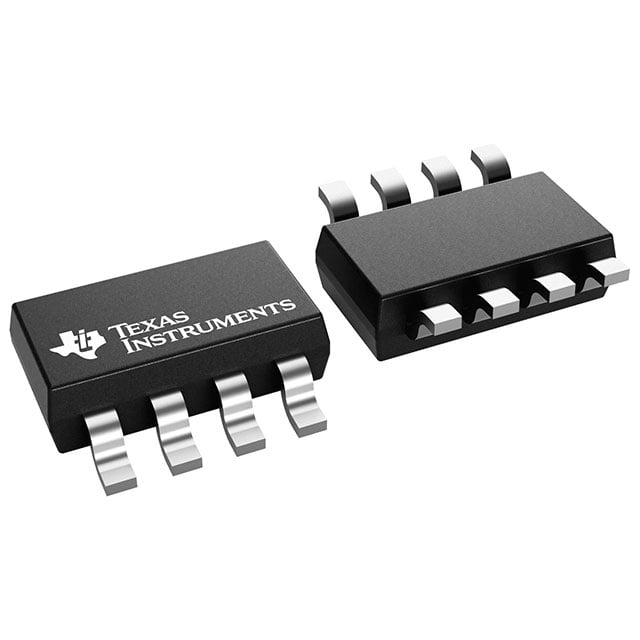
Key Specs
| Spec | Value | Condition | Source |
|---|---|---|---|
| Amplifier Type | Current Sense | Digi-Key | |
| Current Input Bias | 500 pA | Digi-Key | |
| Gain Bandwidth Product | 45 kHz | Digi-Key | |
| Mounting Type | Surface Mount | Digi-Key | |
| Number Of Circuits | 1 | Digi-Key | |
| Operating Temperature Range | -40°C ~ 125°C (TA) | Digi-Key | |
| Output Type | Rail-to-Rail | Digi-Key | |
| Package Case | SOT-23-8 Thin, TSOT-23-8 | Digi-Key | |
| Quiescent Current (Typ) | 48µA | Digi-Key | |
| Slew Rate | 0.3V/µs | Digi-Key | |
| Supplier Device Package | TSOT-23-8 | Digi-Key | |
| Voltage Input Offset | 3 µV | Digi-Key | |
| Voltage Supply Span (Max) | 5.5 V | Digi-Key | |
| Voltage Supply Span (Min) | 1.7 V | Digi-Key |
When To Use
-
Medium-range current sensing on 10mΩ shunt → 0–200mA @ 3.3V supply: At 50V/V gain, the INA186A2IDDFR converts a 10mV shunt drop (at 200mA) to a 500mV output — appropriate for an ADC with 1V full-scale reference. The A1 variant (25V/V) would produce only 250mV at 200mA, wasting half the ADC range and reducing effective resolution by 1 bit. The A3 variant (100V/V) would saturate at 100mA (100 × 10mV = 1000mV clips a 1V reference), cutting the measurement range in half. A2 is the correct gain when current range is 0–200mA and offset tolerance is 3µV.
-
Precision current measurement with minimal offset drift: The input offset voltage of 3 µV and ultra-low input bias current of 500 pA enable highly accurate shunt resistor measurements in low-current or low-voltage-drop scenarios. A lower-quality CSA with higher offset or input bias would cause significant measurement error, resulting in incorrect current reporting or control instability.
-
Power-managed sensor node with firmware-controlled current measurement (1.7V–5.5V supply): The TSOT-23-8 package includes an ENABLE pin (VIH = 1.2V, VIL = 0.4V) that a host MCU can pull low to disable the INA186A2IDDFR during standby, cutting supply current from 48µA to 1µA maximum — a 48× reduction. In a duty-cycled industrial sensor sampling every 5 seconds with 100ms active windows, this reduces CSA energy from 2.5mWh/day to 0.053mWh/day at 3.3V. Using the DCK (SC70-6, no ENABLE) variant requires an external series MOSFET to achieve equivalent power gating, adding BOM cost and layout area.
When Not To Use
-
Fast switching power converter current loop (>100 kHz): The 45 kHz gain bandwidth product is insufficient for accurate sensing in high-frequency switching nodes. Use a higher-bandwidth current-sense amplifier to avoid signal distortion and phase lag that can cause instability or incorrect current limit triggers.
-
Galvanic isolation required for high-side current measurement: This part has no built-in isolation and is referenced to the ground rail. For systems requiring isolation to prevent ground loops or high-voltage hazards, select an isolated current-sense amplifier.
-
High-current measurement above 50 A with minimal power loss: The need for a shunt resistor and the package’s limited thermal dissipation capability make this impractical. Use a Hall-effect current sensor to avoid excessive shunt power dissipation and thermal runaway risk.
Application Notes
-
The TSOT-23-8 package pins 1 and 8 are supply pins; ensure tight decoupling close to these pins to minimize supply noise coupling into the input stage.
-
Pins 2 and 3 are the differential inputs; route the shunt resistor connections with matched length and minimal parasitic inductance to maintain measurement accuracy and prevent noise injection.
-
The enable (EN) pin threshold is 1.2 V (typical high) and 0.4 V (typical low); this pin should have a clean digital input with no slow edges or floating conditions to avoid unpredictable startup or shutdown behavior.
-
Because the package is small and thermally constrained, avoid large power dissipation in the shunt resistor or continuous high current that causes internal temperature rise beyond 125°C ambient rating.
-
Guard routing or ground pours should be implemented around the sensitive input traces to reduce EMI pickup, especially if the switching node (SW) nearby operates at high di/dt.
Related Calculators
- Current Sense / Shunt Resistor Calculator — Size your shunt resistor for this amplifier
Gotchas
-
EN pin floating or slow ramp on enable line: Designers may assume leaving EN unconnected defaults to enabled. The enable input requires a defined logic level; floating or slow-ramping signals near 0.4–1.2 V cause output oscillations or unexpected shutdown. Fix by adding a pull-up or pull-down resistor to set a defined EN state during startup.
-
Assuming rail-to-rail output is linear at both rails under heavy load: The output stage is rail-to-rail but limited by the 0.3 V/µs slew rate. Fast transient loads with large current steps can cause output slew-rate induced distortion, appearing as slow output settling or measurement lag. Use scope to verify output edge rates and consider slower load changes or adding filtering.
-
Neglecting the TSOT-23-8 package’s limited thermal path: When placed on a tightly packed PCB with minimal copper area for heat dissipation, the device may exceed its 125°C max ambient rating under continuous load. This leads to thermal drift and potential device failure. Add dedicated thermal vias or copper pours connected to the device’s exposed pad area if present.
-
Routing input pins too close to noisy switching nodes (SW): Proximity to high-frequency switching signals can couple noise onto the input pins 2 and 3, causing jitter or offset errors in the sensed current. Maintain physical separation and use ground shielding between the SW node and current sense inputs.