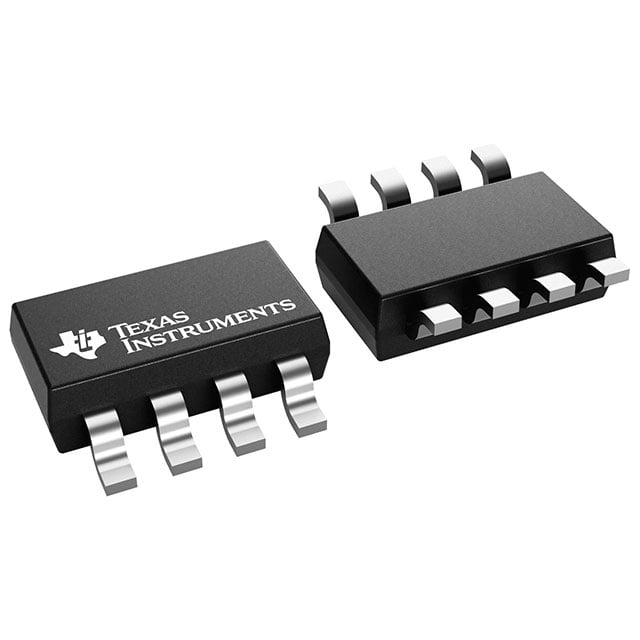
Key Specs
| Spec | Value | Condition | Source |
|---|---|---|---|
| Amplifier Type | Current Sense | Digi-Key | |
| Current Input Bias | 500 pA | Digi-Key | |
| Gain Bandwidth Product | 45 kHz | Digi-Key | |
| Mounting Type | Surface Mount | Digi-Key | |
| Number Of Circuits | 1 | Digi-Key | |
| Operating Temperature Range | -40°C ~ 125°C (TA) | Digi-Key | |
| Output Type | Rail-to-Rail | Digi-Key | |
| Package Case | SOT-23-8 Thin, TSOT-23-8 | Digi-Key | |
| Quiescent Current (Typ) | 48µA | Digi-Key | |
| Slew Rate | 0.3V/µs | Digi-Key | |
| Supplier Device Package | TSOT-23-8 | Digi-Key | |
| Voltage Input Offset | 3 µV | Digi-Key | |
| Voltage Supply Span (Max) | 5.5 V | Digi-Key | |
| Voltage Supply Span (Min) | 1.7 V | Digi-Key |
When To Use
-
Low-side current sensing in 5 V systems @ 10 mA to 100 mA: The 3 µV input offset voltage and 500 pA input bias current enable precise current measurement of low currents with minimal error. Using a generic amplifier with higher input bias would cause offset drift and inaccurate readings, resulting in poor current regulation or false fault detection.
-
Battery-powered sensor node requiring ultra-low quiescent current: The 48 µA typical quiescent current allows extended battery life compared to general-purpose amplifiers that consume milliamps, which would drain batteries prematurely. A synchronous buck controller or switching regulator might improve efficiency but introduces switching noise incompatible with sensitive analog measurements.
-
Current sense amplifier in a 1.7 V to 5.5 V single-supply system: The wide supply voltage range and rail-to-rail output ensure full dynamic range measurement across typical low-voltage rails without clipping or distortion. Using an amplifier with a higher minimum supply voltage would cause output saturation and loss of measurement in low-voltage systems.
When Not To Use
-
High-frequency current sensing above 100 kHz switching frequency: Gain bandwidth product of 45 kHz and slew rate of 0.3 V/µs limit frequency response, causing phase lag and distortion. Use a high-frequency buck controller designed for switching frequencies > 500 kHz instead.
-
Current sensing in applications exceeding 125°C ambient operating temperature: The maximum operating temperature of 125°C TA disqualifies this part in automotive under-hood or industrial high-temp zones. Choose a multi-phase buck controller with extended temperature ratings for robust operation.
-
Low noise linear regulation with input-output differential < 1 V: The INA186A1IDDFR is a current sense amplifier, not a regulator, and lacks the low dropout and noise characteristics needed for tight voltage regulation with small input-output differential. Use an LDO regulator for those requirements.
Application Notes
- Pins 2 and 3 are the differential current sense inputs; ensure the sense resistor is placed as close as possible to these pins with Kelvin connections to minimize parasitic resistance and noise pickup.
- The output (pin 6) is rail-to-rail but requires a clean, low-impedance load to maintain linear performance; avoid capacitive loading without a series resistor to prevent stability issues.
- The supply pins (V+ pin 8 and GND pin 4) must have solid bypass capacitors placed within 5 mm of the device to suppress supply noise coupling into the input stage, which can cause offset drift.
- Avoid routing noisy switching nodes or high di/dt traces near the input pins to prevent injection of switching noise into the amplifier input, which degrades measurement accuracy.
- Guard routing around input pins 2 and 3 is recommended to shield the high-impedance inputs from board-level leakage currents, especially in humid or contaminated environments.
Pin numbers are package-specific. Verify against the datasheet pinout diagram before routing.
Gotchas
-
Offset voltage drift under temperature cycling: Although the offset voltage is specified at 3 µV typical, the datasheet graphs show that offset voltage can drift significantly near the -40°C or 125°C extremes. This drift can cause apparent current measurement shifts invisible in room temperature bench tests. Fix: Characterize offset drift over the full temperature range during design validation and include temperature compensation or calibration if needed.
-
Output saturation at supply rails during transient load steps: The 0.3 V/µs slew rate limits how fast the output can respond to sudden current changes. This can cause output voltage clipping near rails during fast transient events, leading to distorted current measurements. Fix: Verify transient response with a scope on the actual load and consider adding a small series resistor on the output to linearize response.
-
Input bias current interaction with high-value sense resistors: Although input bias current is low (500 pA), using sense resistors > 10 kΩ can create measurable voltage drops at the input, causing offset errors that are not obvious in simulation. Fix: Keep sense resistor values low (< 1 kΩ) or compensate for bias current in system calibration.
-
Startup sequencing causing output clamp or lockup: If the supply voltage ramps slowly or if the device input common-mode voltage is outside the supply rails during power-up, the amplifier output may latch near one rail and fail to recover without power cycling. Fix: Ensure clean, monotonic power supply ramp and that input common-mode voltages remain within specified supply limits during startup.
Related Calculators
- Current Sense / Shunt Resistor Calculator — Size your shunt resistor for this amplifier’s gain and V_ref