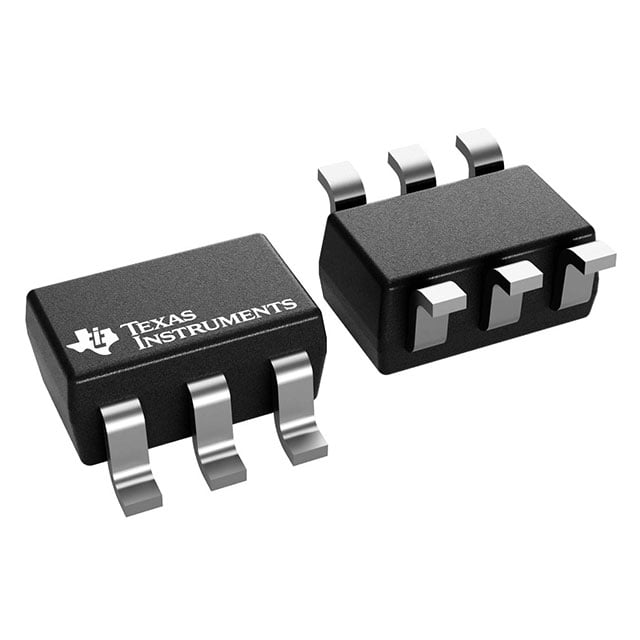
Key Specs
| Spec | Value | Condition | Source |
|---|---|---|---|
| Amplifier Type | Current Sense | Digi-Key | |
| Current Input Bias | 500 pA | Digi-Key | |
| Gain Bandwidth Product | 45 kHz | Digi-Key | |
| Mounting Type | Surface Mount | Digi-Key | |
| Number Of Circuits | 1 | Digi-Key | |
| Operating Temperature Range | -40°C ~ 125°C (TA) | Digi-Key | |
| Output Type | Rail-to-Rail | Digi-Key | |
| Package Case | 6-TSSOP, SC-88, SOT-363 | Digi-Key | |
| Quiescent Current (Typ) | 48µA | Digi-Key | |
| Slew Rate | 0.3V/µs | Digi-Key | |
| Supplier Device Package | SC-70-6 | Digi-Key | |
| Voltage Input Offset | 3 µV | Digi-Key | |
| Voltage Supply Span (Max) | 5.5 V | Digi-Key | |
| Voltage Supply Span (Min) | 1.7 V | Digi-Key |
When To Use
-
Low-level current sensing in battery management systems: The INA186A1IDCKR’s ultra-low input bias current of 500 pA minimizes offset errors when measuring microamp-level currents, critical for accurate state-of-charge estimation. Using a standard current sense amplifier with higher bias current would cause drift and false readings, potentially leading to overcharge or deep discharge.
-
Precision current monitoring in industrial motor drives: The 3 µV voltage input offset combined with rail-to-rail output enables accurate sensing of small differential voltages across shunts at supply voltages as low as 1.7 V and up to 5.5 V. A generic amplifier lacking rail-to-rail output would saturate or clip near supply rails, causing loss of signal fidelity and false trip conditions.
-
Space-constrained sensor node with tight power budget: The 48 µA quiescent current and SC-70-6 package make the INA186A1IDCKR ideal where PCB area and power are limited, such as in dense sensor arrays. Using a higher-IQ part or larger package would increase power consumption or require more PCB real estate, possibly triggering thermal hotspots or layout constraints.
When Not To Use
-
Current sensing above 125°C ambient: The maximum operating temperature of 125°C disqualifies this part for high-temperature environments like automotive under-hood. Use an isolated flyback or other temperature-hardened controller designed for >150°C operation instead.
-
High-frequency switching power supplies above 500 kHz: The 45 kHz gain-bandwidth product and 0.3 V/µs slew rate limit dynamic response speed, causing phase lag and instability at high switching frequencies. Use a high-frequency buck controller for switching frequencies >500 kHz.
-
Battery-powered devices requiring ultra-low quiescent current in standby: The 48 µA typical quiescent current is too high for μA-scale sleep-mode loads where battery life is critical. Use a low-IQ PFM buck or dedicated low-power amplifier optimized for sub-μA standby current.
Application Notes
-
the IN+ pin and the IN− pin are the current sense inputs and must be routed with matched, symmetrical traces close to the shunt resistor to minimize parasitic inductance and noise pickup.
-
The output pin (Pin 6) is rail-to-rail but requires a clean, low-impedance reference ground to maintain offset accuracy; guard routing around input pins reduces leakage currents that degrade the 500 pA bias.
-
Supply pins (Pin 2 and Pin 5) must be decoupled with at least 0.1 µF ceramic capacitors placed as close as possible to minimize supply ripple affecting the low-level input offset.
-
Avoid running high-current switching nodes or noisy digital signals parallel and close to the input traces to prevent capacitive coupling that can cause output jitter or offset shifts.
-
The SC-70-6 package’s thermal path is limited; ensure PCB thermal vias under the footprint are included if the quiescent current dissipates heat in continuous operation near 125°C.
Pin numbers are package-specific. Verify against the datasheet pinout diagram before routing.
Related Calculators
- Current Sense / Shunt Resistor Calculator — Size your shunt resistor for this amplifier
Gotchas
-
Input bias current shifts due to humidity and contamination: The 500 pA input bias current spec assumes clean, dry PCB surfaces. Contamination or moisture on the PCB near the input pins can raise leakage currents by orders of magnitude, causing large offset errors. Fix: Use conformal coating or keep the input area clean and guard-routed to minimize leakage paths.
-
Output saturation when supply voltage dips below 1.7 V during transient dips: Although the minimum supply voltage is 1.7 V, fast transient supply dips below this cause the output stage to saturate unpredictably. This results in apparent signal loss or clipping during load steps. Fix: Add supply voltage supervision or a power-fail reset to ensure operation stays within the 1.7–5.5 V window.
-
Slow slew rate causing measurement errors on fast current transients: The 0.3 V/µs slew rate limits response to rapid current changes, causing output lag and undershoot in fast switching loads. This can be misinterpreted as measurement inaccuracies or hardware faults. Fix: Confirm transient response with scope and consider filtering or slower load edges if accuracy is critical.
-
Offset drift when input common-mode voltage approaches rails: Near the supply rails, the input offset voltage can drift beyond the 3 µV nominal, causing output error in low-level sensing. This is subtle and may appear as baseline shifts over temperature or input range. Fix: Validate offset stability over the full input common-mode range in target application conditions.