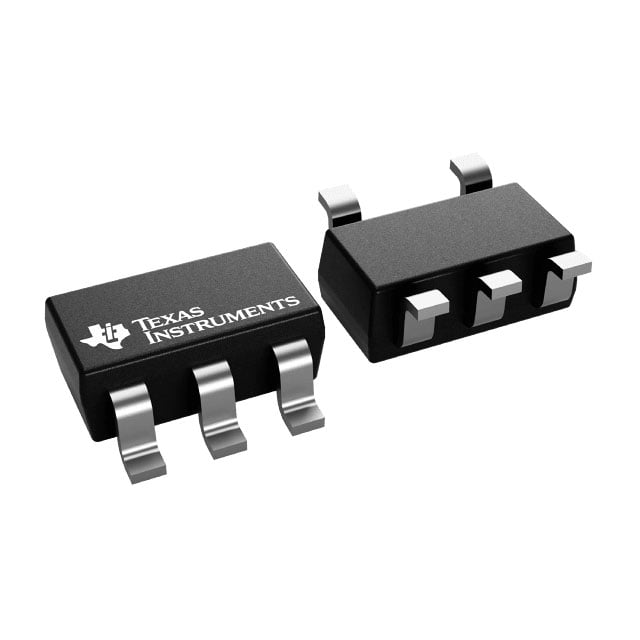
Key Specs
| Spec | Value | Condition | Source |
|---|---|---|---|
| 3db Bandwidth | 350 kHz | Digi-Key | |
| Amplifier Type | Current Sense | Digi-Key | |
| Current Input Bias | 80 µA | Digi-Key | |
| Mounting Type | Surface Mount | Digi-Key | |
| Number Of Circuits | 1 | Digi-Key | |
| Operating Temperature Range | -40°C ~ 125°C | Digi-Key | |
| Output Type | Rail-to-Rail | Digi-Key | |
| Package Case | SC-74A, SOT-753 | Digi-Key | |
| Quiescent Current (Typ) | 260µA | Digi-Key | |
| Slew Rate | 2V/µs | Digi-Key | |
| Supplier Device Package | SOT-23-5 | Digi-Key | |
| Voltage Input Offset | 100 µV | Digi-Key | |
| Voltage Supply Span (Max) | 5.5 V | Digi-Key | |
| Voltage Supply Span (Min) | 2.7 V | Digi-Key |
When To Use
-
Low-side current sensing in 3.3V rail @ 1A: The 2.7 V minimum supply voltage and rail-to-rail output enable direct interface with low-voltage digital systems without level shifting. The 100 µV input offset voltage ensures accurate measurement of low currents through small shunt resistors, where a higher offset would cause significant relative error.
-
Thermally constrained PCB with limited copper area: The SOT-23-5 package minimizes PCB footprint and is suitable for compact layouts where board area is premium. Larger packages would allow better thermal conduction but at the cost of space; here, the tradeoff favors compactness over thermal dissipation, assuming quiescent current of 260 µA keeps power low.
-
Bandwidth-limited current monitoring for motor control < 350 kHz: The 3 dB bandwidth of 350 kHz and 2 V/µs slew rate fit current sensing in PWM-driven motor phases up to medium switching frequencies without excessive lag or distortion. A device with lower bandwidth would cause phase delay and amplitude attenuation, potentially destabilizing current feedback loops.
When Not To Use
-
High-frequency switching current measurement > 1 MHz: The 350 kHz bandwidth is insufficient to capture fast transient currents in high-frequency DC-DC converters. Use a higher-bandwidth current-sense amplifier to avoid aliasing and inaccurate representation of switching waveforms.
-
Measuring high-side current on a 48 V bus with galvanic isolation required: The lack of galvanic isolation and maximum supply voltage of 5.5 V make this part unsuitable for direct high-voltage rail sensing. An isolated current-sense amplifier should be used to prevent damage and ensure operator safety.
-
Precision measurement requiring sub-50 µV offset voltage: The 100 µV input offset voltage may introduce unacceptable error in low-current or high-accuracy measurement systems. A lower-offset current-sense amplifier is needed to maintain measurement fidelity.
Application Notes
-
The SOT-23-5 package pins are closely spaced, requiring careful PCB layout to avoid solder bridging and ensure reliable solder joints; use solder mask-defined pads and 5 mil minimum trace clearance around pins.
-
the input+ pin and the input− pin are the current sense inputs; route these traces with symmetrical impedance and keep them short to reduce noise pickup and offset errors.
-
The output pin (typically Pin 5) is rail-to-rail and should be buffered with a low-impedance input stage if driving long cables or capacitive loads; excessive capacitive loading can cause output instability.
-
Because the package has limited thermal conduction paths, ensure the PCB copper area connected to the ground pin is maximized within layout constraints to aid heat dissipation.
-
Avoid routing noisy switching nodes (SW) near the input pins to prevent capacitive coupling; use ground guard traces or split ground planes to shield sensitive inputs.
Pin numbers are package-specific. Verify against the datasheet pinout diagram before routing.
Related Calculators
- Current Sense / Shunt Resistor Calculator — Size your shunt resistor for this amplifier
Gotchas
-
[Offset drift under temperature]: The 100 µV input offset voltage is typical at 25°C but can drift significantly toward the edges of the −40°C to 125°C range, causing measurement error that appears as slow baseline shifts in current sensing. Fix by characterizing offset drift at operating temperatures and implementing calibration or offset compensation in firmware.
-
[SOT-23-5 rework difficulty]: The small package size and fine pitch make manual solder rework error-prone, leading to intermittent open or shorted pins that cause erratic output readings without visible damage. Fix by using hot air rework stations with precise nozzle control and inspecting joints under magnification after reflow.
-
[Output stability with capacitive loads]: The rail-to-rail output stage can oscillate or ring when driving capacitive loads above approximately 10 pF, resulting in ringing on the output waveform that distorts current measurement. Fix by adding a small series resistor (5–10 Ω) between the output pin and capacitive load or buffering with a voltage follower stage.
-
[Input bias current causing offset]: The 80 µA input bias current flowing through the shunt resistor can generate a voltage offset indistinguishable from the measured signal, especially with high-value shunt resistors. This causes a fixed offset current measurement error. Fix by selecting appropriately low-value shunts and verifying input bias current impact in simulation or prototype measurement.