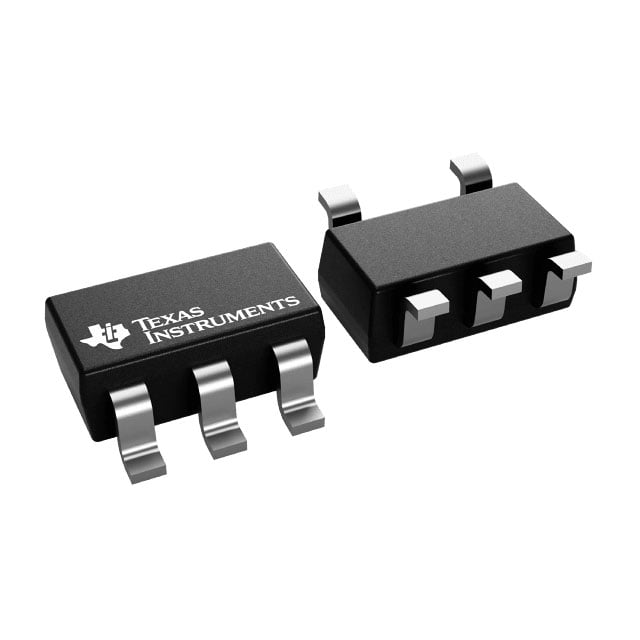
Key Specs
| Spec | Value | Condition | Source |
|---|---|---|---|
| 3db Bandwidth | 350 kHz | Digi-Key | |
| Amplifier Type | Current Sense | Digi-Key | |
| Current Input Bias | 80 µA | Digi-Key | |
| Mounting Type | Surface Mount | Digi-Key | |
| Number Of Circuits | 1 | Digi-Key | |
| Operating Temperature Range | -40°C ~ 125°C | Digi-Key | |
| Output Type | Rail-to-Rail | Digi-Key | |
| Package Case | SC-74A, SOT-753 | Digi-Key | |
| Quiescent Current (Typ) | 260µA | Digi-Key | |
| Slew Rate | 2V/µs | Digi-Key | |
| Supplier Device Package | SOT-23-5 | Digi-Key | |
| Voltage Input Offset | 100 µV | Digi-Key | |
| Voltage Supply Span (Max) | 5.5 V | Digi-Key | |
| Voltage Supply Span (Min) | 2.7 V | Digi-Key |
When To Use
-
Low-side current sensing in 3.3V embedded systems @ 1A: The 2.7V minimum supply voltage and 20 V/V gain make INA180A1IDBVR well suited for low-voltage rails where the output swings rail-to-rail. An amplifier with a higher input bias current or offset would distort the sensed current, causing inaccurate measurements and potential miscontrol.
-
Battery management system monitoring at ambient to 125°C: The specified -40°C to 125°C operating range covers most automotive and industrial environments. Choosing a part with a narrower temperature range risks output drift or device failure, leading to erroneous current reporting and possible battery damage.
-
Compact PCB current sense around a 1A motor driver: The SOT-23-5 package minimizes PCB footprint, enabling dense layouts in space-constrained systems. Larger packages would increase board area and introduce longer thermal paths, risking localized overheating and complicating rework under tight space constraints.
When Not To Use
-
High-frequency switching node current sensing > 1 MHz: The 350 kHz -3dB bandwidth limits accurate measurement of fast transient currents. Use a higher-bandwidth current-sense amplifier to avoid measurement lag and ringing that cause distorted current waveforms.
-
Measuring low-level currents where offset < 50 µV is critical: The 100 µV input offset voltage may introduce unacceptable errors in microamp-level sensing. Use a lower-offset current-sense amplifier to prevent offset-induced drift and false readings.
-
High-current (>50A) shunt sensing in power distribution: The power dissipation in the shunt resistor at high currents exceeds practical limits for this part’s input voltage and package thermal path. Use a Hall-effect current sensor to eliminate shunt losses and achieve galvanic isolation.
Application Notes
- Pin 2 is the input connected to the shunt resistor’s low side; keep this node’s trace short and low impedance to reduce noise pickup.
- Pin 3 is the input connected to the shunt resistor’s high side; route symmetrically and avoid large loops with Pin 2 to minimize common-mode noise.
- The SOT-23-5 package has limited thermal conduction through its small exposed pads; maximize copper area under the device on the PCB to improve heat dissipation.
- Avoid routing high-current switching nodes (SW) near the input pins (2 and 3) to prevent capacitive coupling that can cause output jitter or offset shifts.
- Guard routing or ground fills around input pins help reduce interference pickup, especially in noisy switching environments common with motor drives or DC/DC converters.
Pin numbers are package-specific. Verify against the datasheet pinout diagram before routing.
Related Calculators
- Current Sense / Shunt Resistor Calculator — Size your shunt resistor for this amplifier
Gotchas
-
[Offset drift with temperature overlooked]: Designers may assume the 100 µV offset is constant, but it typically drifts with temperature, causing a slowly varying error that looks like load current changes.
What happens: Output slowly shifts during temperature cycling, confusing control loops or diagnostics.
Fix: Measure offset over temperature in your setup or add offset calibration routines during system operation. -
[Insufficient PCB copper area causing thermal issues]: The small SOT-23-5 package relies on PCB copper for heat dissipation; minimal copper can cause junction temperature to rise beyond limits under continuous load.
What happens: Device parameters drift or device shuts down unexpectedly due to thermal stress not predicted by steady-state power calculations alone.
Fix: Design a thermal pad with at least 100 mm² of copper area connected to the package’s exposed pad and verify temperature with thermal imaging or simulation. -
[Input bias current causing voltage drop across shunt resistor leads]: The 80 µA input bias current flowing through PCB traces or connector resistances can create an offset voltage indistinguishable from load current.
What happens: The output shows a constant offset current even at zero load, misleading diagnostics.
Fix: Use Kelvin sensing techniques with dedicated PCB traces routed separately from power lines and keep trace resistance below a few milliohms. -
[Output saturation at supply rails during transient inputs]: The 2 V/µs slew rate limits fast transient response; sudden load current steps can cause output to saturate or temporarily clip.
What happens: The control system sees a distorted current waveform, causing erratic behavior or false fault detection.
Fix: Add a small RC filter on the output or size the shunt resistor and gain to keep output within linear range for expected transient currents.