FDC6321C vs FDC5614P MOSFET Comparison
Quick verdict
For low-voltage, low-current logic-level switching with complementary N- and P-channels in a very compact footprint, the FDC6321C is the better choice due to its integrated half-bridge configuration and very low gate charge. For higher-voltage, higher-current single P-channel applications—especially where 60 V blocking and up to 3 A continuous current are required—the FDC5614P is a clear winner despite its higher gate charge and larger R_DS(on).
Spec comparison table
| Spec | FDC6321C | FDC5614P | Notes |
|---|---|---|---|
| Configuration | N and P-Channel | P-Channel | FDC6321C offers dual complementary FETs for half-bridge or push-pull topologies. |
| Max Drain-Source Voltage (V_DS max) | 25 V | 60 V | FDC5614P supports higher voltage applications, doubling margin over FDC6321C. |
| Continuous Drain Current (I_D @ 25°C) | 680 mA (N), 460 mA (P) | 3 A | FDC5614P handles 4–6× more current, suitable for higher power loads. |
| Max Power Dissipation (P_D max) | 700 mW | 1.6 W | FDC5614P dissipates over twice the power, aiding thermal management at higher currents. |
| R_DS(on) max @ I_D, V_GS | 450 mΩ @ 0.5 A, 4.5 V | 105 mΩ @ 3 A, 10 V | FDC5614P has significantly lower on-resistance at its rated current, improving efficiency. |
| Gate Charge Q_g max @ V_GS | 2.3 nC @ 5 V | 24 nC @ 10 V | FDC6321C’s gate charge is ~10× lower, easing gate driver requirements and switching losses. |
| Input Capacitance C_iss max @ V_DS | 50 pF @ 10 V | 759 pF @ 30 V | Lower input capacitance in FDC6321C reduces switching losses and EMI at low voltages. |
| Gate Threshold Voltage V_GS(th) max | 1.5 V @ 250 µA | 3 V @ 250 µA | FDC6321C turns on at a lower gate voltage, better for low-voltage logic-level drive. |
| Gate-Source Voltage max | Not explicitly stated (typical ±20 V) | ±20 V | Similar robustness; no clear advantage. |
| Operating Temperature Range | -55°C to 150°C (TJ) | -55°C to 150°C (TJ) | Both have identical thermal operating ranges. |
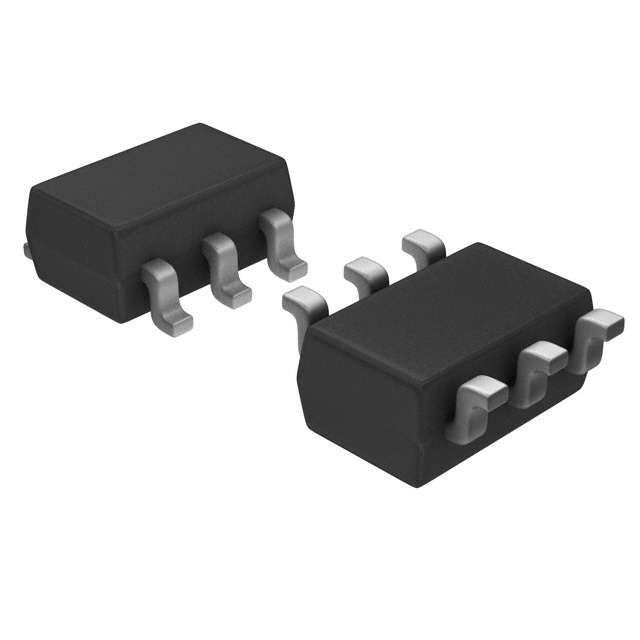
| Package | SuperSOT™-6 (TSOT-23-6) | SuperSOT™-6 (TSOT-23-6) | Identical package; footprint likely similar or identical. |
| Mounting Type | Surface Mount | Surface Mount | Both surface mount, suitable for compact PCB layouts. |
Design trade-offs
The FDC6321C integrates matched N- and P-channel MOSFETs in a single SuperSOT-6 package, which is ideal for half-bridge or complementary switching topologies in low-voltage (≤25 V) systems. Its extremely low gate charge (2.3 nC @ 5 V) and very low input capacitance (50 pF) translate directly into minimal switching losses and reduced gate driver power consumption, which is important in battery-powered or low-power control circuits. However, its maximum continuous current capability (680 mA N, 460 mA P) and relatively high R_DS(on) (450 mΩ @ 0.5 A) limit its use to low-current loads or signal-level switching.
In contrast, the FDC5614P is a single P-channel MOSFET optimized for higher voltage (60 V) and higher current (3 A) applications, with a power dissipation rating more than twice that of the FDC6321C. Its R_DS(on) of 105 mΩ at 3 A is reasonable for power switching, but the 24 nC gate charge at 10 V is an order of magnitude higher, increasing gate driver losses and slowing switching speed. The large input capacitance (759 pF) means gate drivers must source/sink more current during switching transitions, which can affect EMI and switching efficiency in high-frequency applications.
Thermally, the FDC5614P can handle higher dissipation, but the package size is the same, so careful PCB thermal design is required to avoid hotspots under sustained high current. The FDC6321C’s lower power dissipation rating and current capability make thermal management less challenging but restrict its use to smaller loads.
From a firmware perspective, the lower gate threshold voltage (1.5 V max vs 3 V max) of the FDC6321C means it can be driven directly from 3.3 V logic with more margin, while the FDC5614P requires at least a 4.5–10 V gate drive voltage to achieve low R_DS(on), potentially necessitating a dedicated gate driver or charge pump.
Cost-wise, the FDC6321C’s integration of dual MOSFETs in a single package can reduce BOM and board area in systems needing complementary switches, potentially offsetting higher per-unit cost. The FDC5614P is simpler but may require additional components or larger PCB area to implement complementary stages.
Use-case fit
Choose FDC6321C when…
- Designing low-voltage (<25 V) half-bridge drivers or push-pull circuits with low current (<0.7 A) requirements.
- Implementing logic-level switching directly driven from 3.3 V microcontrollers without dedicated gate drivers.
- Minimizing switching losses and gate drive power in low-frequency or PWM applications.
- Space-constrained designs needing dual complementary MOSFETs in a single small package.
- Sensitive analog or mixed-signal circuits where low input capacitance reduces EMI and cross-talk.
Choose FDC5614P when…
- Switching loads up to 60 V with continuous currents up to 3 A, such as battery protection, load switches, or power path control.
- Designs where higher power dissipation (up to 1.6 W) is required without resorting to larger packages.
- Applications tolerant of higher gate drive power and slower switching transitions, such as DC-DC converters operating at moderate frequencies.
- Single-ended P-channel high-side switches where only a P-channel MOSFET is needed.
- Systems with dedicated 10 V gate drivers or charge pumps available to optimize R_DS(on) and efficiency.
Drop-in compatibility
Both devices share the SuperSOT™-6 (TSOT-23-6) package and surface-mount form factor, but the FDC6321C is a dual MOSFET array (N and P), whereas the FDC5614P is a single P-channel MOSFET. They are not functionally pin-compatible: pin assignments differ because the FDC6321C integrates two transistors with separate gates and sources. Substituting one for the other requires circuit redesign, especially if the complementary transistor or dual-FET functionality is needed. Without explicit pinout details from the datasheets, assume no direct drop-in replacement is possible.
Alternatives to consider
- FDS6910 (dual N and P-channel MOSFET array): Similar dual complementary MOSFETs with higher voltage rating and current capability for low-voltage half-bridge applications.
- SI2302CDS (P-channel MOSFET 20 V, 2.8 A): A P-channel device with logic-level gate drive and moderate current rating for low-voltage high-current switching.
- AO3401A (P-channel MOSFET 30 V, 4.2 A): Higher current P-channel MOSFET with low R_DS(on) for battery protection and power path switching.