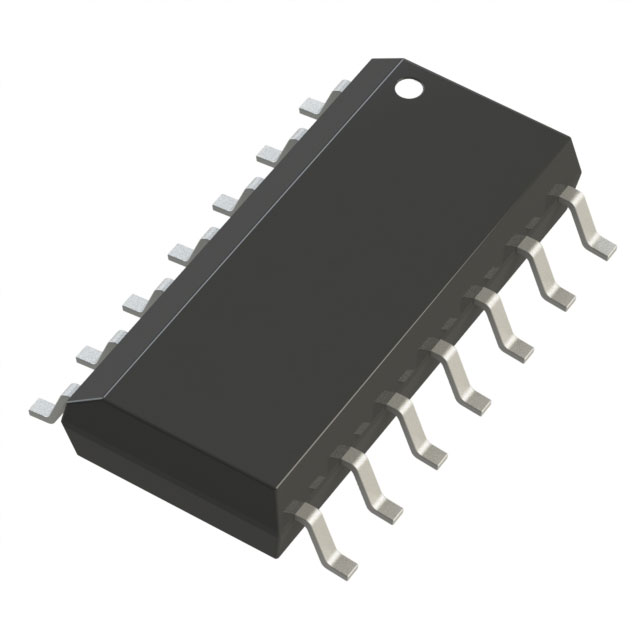
Key Specs
| Spec | Value | Condition | Source |
|---|---|---|---|
| Control Features | Frequency Control, Soft Start | Digi-Key | |
| Duty Cycle | 70% | Digi-Key | |
| Fault Protection | Current Limiting, Over Temperature, Over Voltage, Short Circuit, UVLO | Digi-Key | |
| Grade | - | Digi-Key | |
| Internal Switch S | No | Digi-Key | |
| Mounting Type | Surface Mount | Digi-Key | |
| Operating Temperature Range | -40°C ~ 85°C (TA) | Digi-Key | |
| Output Isolation | Isolated | Digi-Key | |
| Package Case | 14-SOIC (0.154”, 3.90mm Width) | Digi-Key | |
| Qualification | - | Digi-Key | |
| Supplier Device Package | PG-DSO-14-800 | Digi-Key | |
| Supply Voltage (Typ) | 85V ~ 265V | Digi-Key | |
| Switching Frequency (Typ) | 30kHz | Digi-Key | |
| Topology | Flyback, Secondary Side SR | Digi-Key | |
| Voltage Breakdown | 500V | Digi-Key |
When To Use
-
85V–265V AC/DC adapter → 12V @ 1A isolated output: The wide supply voltage range up to 265V and built-in over-voltage and over-temperature protections make this part ideal for universal input isolated flyback designs. Using a non-isolated synchronous buck controller here would risk dangerous ground loops and cannot provide the required isolation barrier.
-
Flyback converter with secondary side synchronous rectification at 30kHz: The fixed typical switching frequency of 30kHz and secondary side synchronous rectifier topology perfectly fit applications targeting moderate EMI and efficiency in isolated power supplies. A non-synchronous flyback controller would suffer higher conduction losses and generate excessive heat under load.
-
Industrial control system operating from -40°C to 85°C ambient: The specified operating temperature range supports harsh environments without derating. Using a low-IQ PFM buck here would not meet the thermal and protection requirements and may fail under fault conditions like short circuit or over-temperature.
When Not To Use
-
Point-of-load converter requiring >500kHz switching for minimal magnetics: The 30kHz switching frequency is far too low for compact magnetics design. Use a high-frequency buck controller instead to achieve smaller inductors and capacitors.
-
Battery-powered sensor node needing ultra-low quiescent current: The internal control and protections imply a quiescent current too high for μA sleep-mode loads. Use a low-IQ PFM buck to extend battery life.
-
High-current (>5A) power supply with critical efficiency: The absence of internal switches and current limiting suited for moderate load currents limits this part’s ability to handle high output currents efficiently. Use a high-current synchronous buck with external FETs to handle higher currents with better efficiency and thermal performance.
Application Notes
The switching node on the primary side of the flyback transformer is the critical switching node and requires the smallest possible loop area to minimize EMI and switching losses. Careful PCB layout with short, wide traces is essential around this node.
The feedback and control pins are noise-sensitive and should be routed away from high-current switching paths to prevent false triggering or instability.
Given the internal switch is not integrated and the device operates with a typical switching frequency of 30kHz and duty cycle up to 70%, a heatsink is generally not required within the specified ambient operating temperature range of -40°C to 85°C. However, thermal management should be verified under worst-case load and ambient conditions.
Gotchas
-
[Soft-start affected by input ripple]: Engineers often assume soft-start is fully internal and stable under all conditions. In reality, input voltage noise near startup can cause the soft-start to abort and restart repeatedly, appearing as output voltage oscillation or delayed startup. Fix by adding a low-ESR input bulk capacitor and RC filtering on the input line.
-
[Incorrect SW node layout causing erratic switching]: Assuming any ground return suffices for the SW node can cause ringing and false triggering of over-voltage or current limit protections. Symptoms include sporadic shutdowns or jitter in switching frequency. Fix by placing the SW node and return loop as a tightly coupled area, minimizing loop inductance and using a ground plane.
-
[Failure to provide minimum load on secondary side]: Because this is a flyback with secondary side synchronous rectification, zero or very light loads may cause output voltage overshoot or unstable regulation. Engineers expecting stable no-load operation can see output voltage spikes or audible noise. Fix by adding a small bleed resistor or minimum load to stabilize output voltage during light load.
-
[Ignoring derating at high ambient temperatures]: While the operating range is -40°C to 85°C, power dissipation limits decrease near 85°C, which is not explicit in the main spec table. Running continuous full load at high ambient without thermal margin results in thermal shutdown cycling. Fix by verifying junction temperature through thermal simulation and adding heatsinking or airflow as needed.