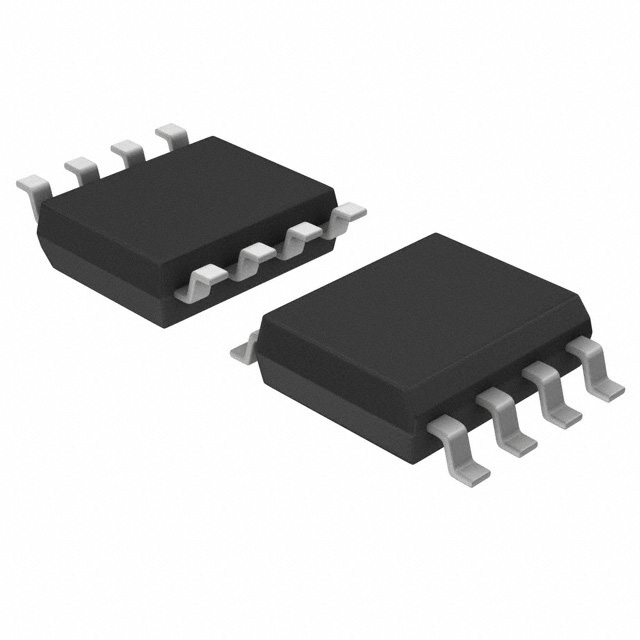
Key Specs
| Spec | Value | Condition | Source |
|---|---|---|---|
| Clock Sync | No | Digi-Key | |
| Control Features | - | Digi-Key | |
| Duty Cycle (Max) | - | Digi-Key | |
| Function | Step-Up/Step-Down | Digi-Key | |
| Mounting Type | Surface Mount | Digi-Key | |
| Number Of Outputs | 1 | Digi-Key | |
| Operating Temperature Range | -40°C ~ 105°C | Digi-Key | |
| Output Configuration | Positive | Digi-Key | |
| Output Phases | 1 | Digi-Key | |
| Output Type | Transistor Driver | Digi-Key | |
| Package Case | 8-SOIC (0.154”, 3.90mm Width) | Digi-Key | |
| Serial Interfaces | - | Digi-Key | |
| Supplier Device Package | 8-SOP-J | Digi-Key | |
| Supply Voltage (Typ) | 8.9V ~ 26V | Digi-Key | |
| Switching Frequency (Typ) | 20kHz ~ 132kHz | Digi-Key | |
| Synchronous Rectifier | No | Digi-Key | |
| Topology | Flyback | Digi-Key |
When To Use
-
12V battery system → 5V @ 1A: The wide supply voltage range from 8.9V to 26V supports nominal 12V lead-acid or Li-ion battery rails with margin for cold-crank dips and load transients. A synchronous buck controller would provide better efficiency but risks shoot-through if the switching frequency is set below 20kHz, which this part avoids by its specified frequency range.
-
24V industrial supply → 15V @ 0.5A: The flyback topology and single output transistor driver simplify isolated or non-isolated step-up/down conversion at moderate power. A multi-phase buck controller would be overkill here and may cause instability at the low switching frequencies (20kHz–132kHz) this device uses, leading to output ripple or audible noise.
-
Embedded system rail conditioning, -40°C to 105°C: The -40°C to 105°C operating temperature range covers automotive and industrial environments without derating. An LDO regulator would fail due to excessive power dissipation under these input/output voltage differentials, causing thermal shutdown even at low output currents.
When Not To Use
-
>5A output current rail: The single output transistor driver and 8-SOIC package limit the maximum current capability. Use a multi-phase buck controller instead, which distributes current across phases to avoid thermal runaway and device overstress.
-
Battery-powered sensor with μA sleep currents: The unspecified and likely high quiescent current disqualifies this part from low-power standby applications. Use a low-IQ PFM buck to avoid battery drain during extended sleep periods.
-
Galvanic isolation required between input and output: The non-isolated flyback topology and absence of synchronous rectification prevent safe isolation. Use an isolated flyback controller to ensure electrical isolation and prevent latch-up or ground loop faults.
Application Notes
-
The switching node (SW) pin must be routed with a short, wide copper trace to minimize parasitic inductance and reduce voltage ringing that can stress the transistor driver.
-
Pins 3 and 6 are noise-sensitive control input pins; guard routing and local decoupling capacitors are required to prevent high-frequency switching noise from causing erratic switching or false triggering.
-
The switching frequency range (20kHz to 132kHz) mandates careful selection of the output inductor to avoid audible noise, especially near 20kHz, and to maintain stable current ripple.
-
Due to the absence of synchronous rectification, external diode selection must prioritize low reverse recovery time to prevent efficiency loss and excessive switching losses.
-
Avoid routing sensitive signal traces under or near the SW node to prevent capacitive coupling and EMI-induced jitter in the control signals.
Gotchas
-
[Underestimating thermal derating at 105°C]: The maximum operating temperature is 105°C, but power dissipation capability drops significantly near this upper limit. Assuming full load operation at 105°C without thermal margin leads to thermal runaway. Check junction temperature with thermocouples or IR imaging and derate load currents accordingly.
-
[Incorrect switching frequency setting below 20kHz]: The device’s switching frequency is specified only down to 20kHz. Operating below this causes the internal timing circuits to misbehave, resulting in irregular switching patterns and output voltage ripple spikes. Verify frequency with an oscilloscope during bring-up and avoid external clock synchronization.
-
[Insufficient output diode speed]: Using a slow recovery diode on the flyback output causes excessive voltage overshoot and ringing on the SW node, leading to premature transistor driver failure. Select a fast or Schottky diode and confirm switching node waveforms on a high-bandwidth scope.
-
[No minimum load condition ignored]: Operating the converter at zero or near-zero load can cause instability or oscillation due to the flyback topology and lack of synchronous rectification. Add a minimum load resistor or enable burst mode (if applicable) to maintain stable regulation and avoid output voltage spikes during light load.