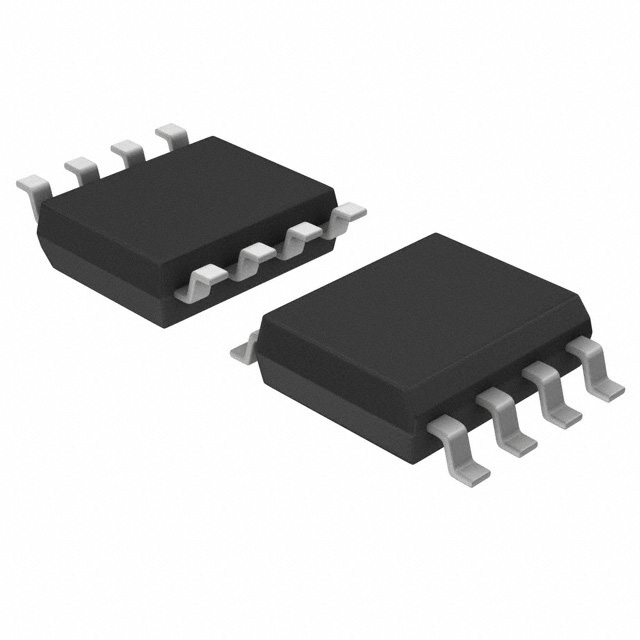
Key Specs
| Spec | Value | Condition | Source |
|---|---|---|---|
| Control Features | Soft Start | Digi-Key | |
| Duty Cycle | 75% | Digi-Key | |
| Fault Protection | Current Limiting, Over Load, Over Voltage, Short Circuit | Digi-Key | |
| Internal Switch S | Yes | Digi-Key | |
| Mounting Type | Surface Mount | Digi-Key | |
| Operating Temperature Range | -40°C ~ 105°C | Digi-Key | |
| Output Isolation | Isolated | Digi-Key | |
| Package Case | 8-SOIC (0.154”, 3.90mm Width) | Digi-Key | |
| Supplier Device Package | 8-SOP-J | Digi-Key | |
| Supply Voltage (Typ) | 8.9V ~ 26V | Digi-Key | |
| Switching Frequency (Typ) | 30kHz ~ 120kHz | Digi-Key | |
| Topology | Flyback | Digi-Key | |
| Voltage Breakdown | 600V | Digi-Key | |
| Voltage Start Up | 13.5 V | Digi-Key |
When To Use
Use the BM1Q021FJ-E2 in isolated flyback power supply designs requiring a supply voltage range of 8.9V to 26V and a switching frequency between 30kHz and 120kHz. It is ideal for applications demanding built-in fault protections such as current limiting, overload, overvoltage, and short circuit, with a maximum duty cycle of 75%. Avoid using this device in non-isolated or synchronous buck regulator applications; instead, consider dedicated buck controller ICs optimized for those topologies.
When Not To Use
-
High-efficiency point-of-load conversion at 12V → 1.8V @ 10A: The integrated switch and 75% duty cycle limit output current and efficiency for high-current loads. Use a high-current synchronous buck with external FETs instead to handle current demands and reduce conduction losses.
-
Battery-powered sensor node needing μA sleep current: The bias current is not optimized for ultra-low quiescent current applications. Use a low-IQ PFM buck to maximize battery life in standby modes.
-
Non-isolated 5V output from 12V input with ≤1V dropout: The flyback topology and isolation make this part unsuitable for low dropout, low-noise applications. Use an LDO regulator when input/output voltage differential is small and noise sensitivity is high.
Application Notes
The internal switch node toggles at the switching frequency range of 30kHz to 120kHz and requires careful PCB layout to minimize the switching loop area, reducing EMI and switching losses. The feedback pin is noise-sensitive and should be routed away from high-current switching traces to maintain stable regulation. Given the device’s operating temperature range of -40°C to 105°C and integrated protections, a heatsink is generally not required under typical load conditions; however, ensure adequate PCB copper area for thermal dissipation in high-power applications.
Gotchas
-
[Startup below 13.5 V assumed safe]: Designers sometimes expect the IC to start at input voltages just below 13.5 V, assuming gradual ramp-up will trigger soft start. Instead, the part remains latched off or oscillates in undervoltage lockout, showing no output voltage.
Fix: Verify input voltage at startup exceeds 13.5 V minimum and add a pre-regulator or supervisor circuit if input is marginal. -
[Feedback and soft-start pin noise coupling]: Routing the feedback (pin 2) or soft-start (pin 3) traces near the SW node causes switching noise injection, leading to output voltage instability and erratic soft-start, visible as output ripple and start-up hiccups.
Fix: Implement guard traces connected to ground between SW and sensitive nodes; route feedback and soft-start traces on a separate PCB layer with ground shielding. -
[Ignoring transformer leakage inductance and parasitic capacitance]: Assuming ideal transformer behavior in simulation leads to underdamped switching waveforms, causing voltage spikes that exceed 600 V breakdown on the internal switch, resulting in device failure during transient load changes.
Fix: Include realistic transformer parasitics in design and add snubber circuits or clamp networks to limit voltage overshoot. -
[Output capacitor ESR too low causing instability]: Using ultra-low ESR ceramic capacitors alone on the output can destabilize the control loop, causing oscillations in output voltage and increased output ripple.
Fix: Add a small ESR capacitor or RC damping network in parallel with ceramics to maintain loop stability as recommended in application notes.