Key Specs
| Spec | Value | Condition | Source |
|---|---|---|---|
| Control Features | Frequency Control, Soft Start | Digi-Key | |
| Duty Cycle | - | Digi-Key | |
| Fault Protection | Current Limiting, Over Load, Over Temperature, Over Voltage, Short Circuit | Digi-Key | |
| Grade | - | Digi-Key | |
| Internal Switch S | Yes | Digi-Key | |
| Mounting Type | Surface Mount | Digi-Key | |
| Operating Temperature Range | -40°C ~ 105°C | Digi-Key | |
| Output Isolation | Isolated | Digi-Key | |
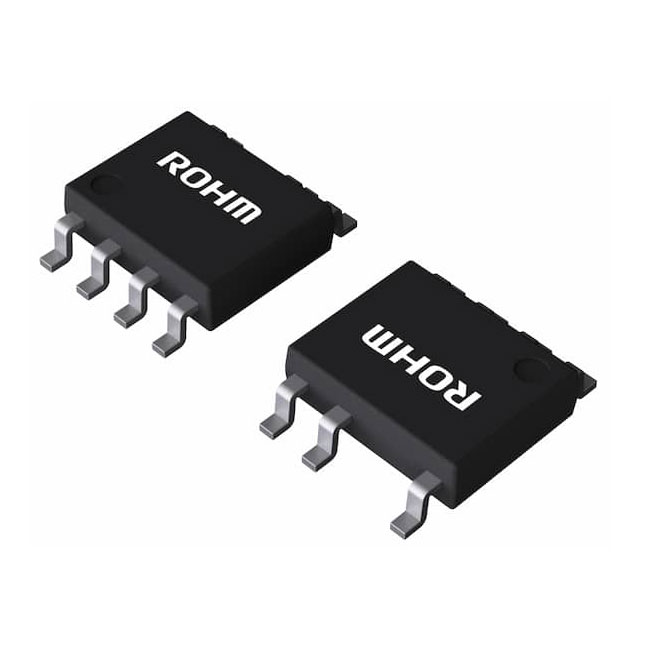
| Package Case | 8-SOIC (0.154”, 3.90mm Width), 7 Leads | Digi-Key | |
| Qualification | - | Digi-Key | |
| Supplier Device Package | 7-SOP-JS | Digi-Key | |
| Supply Voltage (Typ) | 8.9V ~ 26V | Digi-Key | |
| Switching Frequency (Typ) | 120kHz | Digi-Key | |
| Topology | Flyback | Digi-Key | |
| Voltage Breakdown | 650V | Digi-Key | |
| Voltage Start Up | 13.5 V | Digi-Key |
When To Use
Use the BM1Q021AFJ-LBE2 in isolated flyback power supply applications requiring an input supply voltage range of 8.9V to 26V and a switching frequency around 120kHz. Its internal switch and comprehensive fault protections (current limiting, overload, over temperature, over voltage, and short circuit) make it suitable for compact, surface-mount designs operating within -40°C to 105°C. Avoid this device for applications requiring output voltages above its 650V breakdown voltage or where non-isolated topologies are preferred; in such cases, consider other topologies or devices designed for higher voltage ratings and non-isolated operation.
When Not To Use
-
5V high-current server rail → 12V @ 10A: The integrated switch and current limit rating are insufficient for 10A continuous current. Use a multi-phase buck controller to distribute current and reduce thermal stress.
-
Battery-powered wireless sensor → 3.3V @ 100mA standby: The relatively high IQ of this flyback controller and lack of low-power modes make it unsuitable for low quiescent current applications. Use a low-IQ PFM buck instead.
-
Compact smartphone charger → 5V @ 3A with < 1V dropout: The flyback topology and 7-lead 8-SOIC package are not optimized for small size and low noise at low dropout voltages. Use a high-current synchronous buck with external FETs for efficiency and thermal management in tight spaces.
Application Notes
The internal switching node is the drain of the integrated MOSFET and must be routed with the smallest possible loop area to minimize EMI and switching losses. The feedback pin is noise-sensitive and requires careful PCB layout with a low-impedance return path to the device ground to ensure stable operation. Given the device’s internal switch and typical operating conditions, a heatsink is generally not required within the specified operating temperature range of -40°C to 105°C, but thermal considerations should be verified based on the actual power dissipation in the application.
Gotchas
-
[Startup sequencing with undervoltage]: Assuming the device starts cleanly below 13.5V can cause the controller to stay latched off or oscillate during power-up because the internal startup voltage threshold is not met. Symptom: no switching on scope despite proper wiring. Fix: Verify input voltage ramp exceeds 13.5V before enabling the device.
-
[Output capacitor ESR and loop stability]: Using ultra-low ESR ceramic capacitors alone on the secondary side can destabilize the control loop, causing high-frequency oscillations and erratic output voltage ripple. Symptom: output voltage noise and occasional dropout. Fix: Add a small high-ESR capacitor or a parallel RC damping network to maintain loop phase margin.
-
[Layout-induced switching noise coupling]: Routing the SW node trace underneath control or feedback pins without guard traces can couple high dv/dt noise into sensitive inputs, triggering false fault shutdowns or erratic soft start behavior. Symptom: intermittent shutdowns or soft start failures. Fix: Route SW away from control pins and use grounded guard traces.
-
[Load conditions below minimum]: Operating with a load current significantly less than the design minimum or no load at all can cause the internal current limit to oscillate, leading to output voltage instability or audible noise. Symptom: output ripple and switching frequency jitter on the scope. Fix: ensure a minimum load or add a bleed resistor on the output.